



The Phantom Whispers of the Atlantic Edge
At the edge of Cornwall, folklore is rarely separated from landscape. A ruined engine house above a mine valley, an old inn facing a black tide, or a granite promontory exposed to Atlantic weather can carry generations of stories. Night investigators arrive with legends of lost sailors, restless miners, phantom footsteps, and voices heard where no living speaker could be found. The atmosphere is real enough, but atmosphere is not evidence. On a Cornish cliff, the first suspected ghost may be the coastline itself.
Field recordings made near coastal ruins and promontories often contain whispers, knocks, groans, rhythmic pulses, and low thuds. Some arise from distant voices carried across the water. Others are produced by wind striking a microphone, waves compressing air inside fissures, or reflected sound arriving a fraction of a second after the original. If you are conducting a Cornwall ghost hunting investigation, these effects must be treated as part of the site rather than as inconvenient background.
Understanding coastal physics changes the investigator”s role. Instead of listening only for words that resemble a name or plea, you begin by establishing what the location sounds like when nobody is speaking. A baseline recording made in daylight, at several tide states and wind directions, can reveal recurring noises that would otherwise appear supernatural. Only after those natural signatures have been documented can an unusual audio event be considered a serious candidate for an electronic voice phenomenon, or EVP.
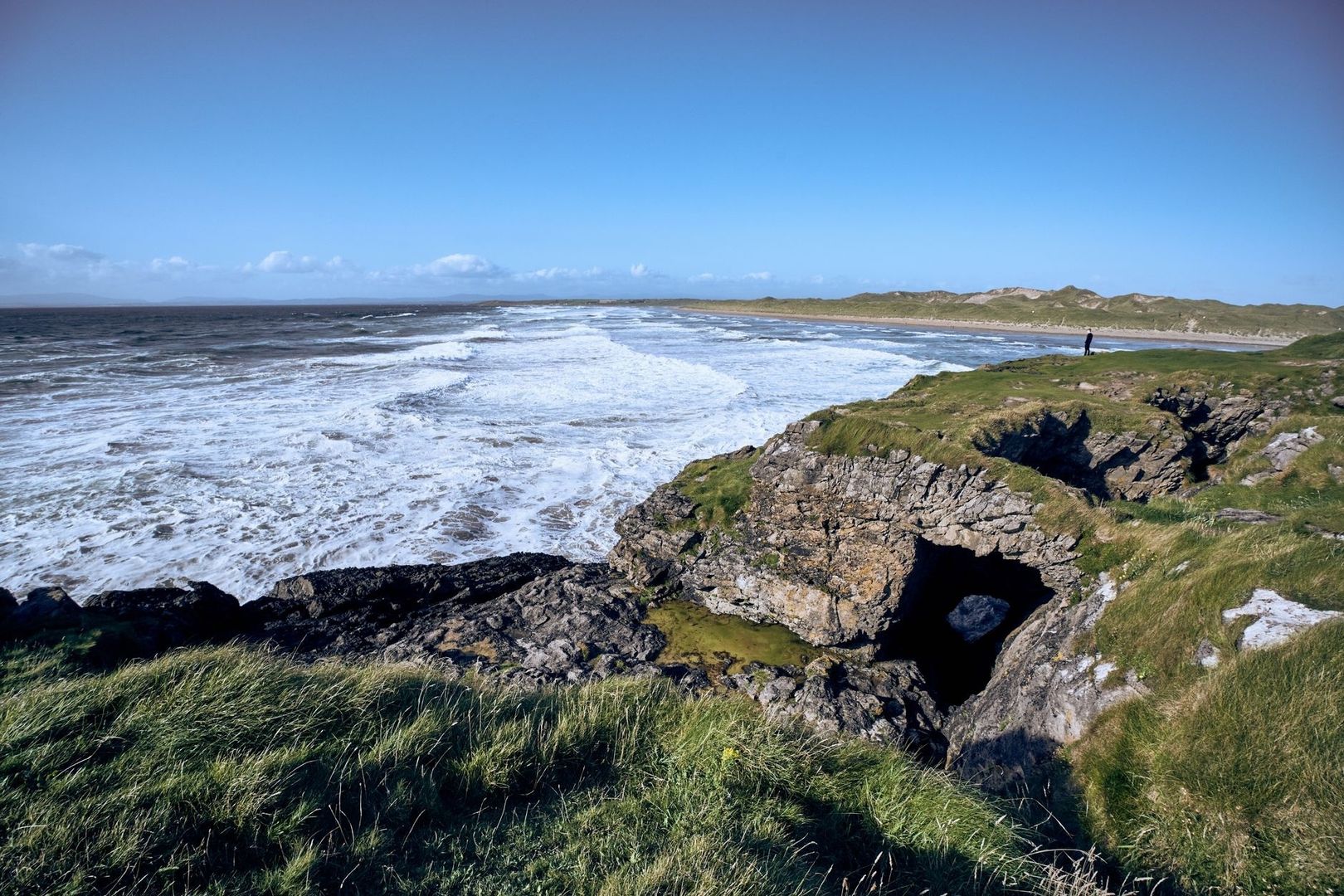
Granite Resonances and Acoustic Mirrors
Granite is dense, hard, and comparatively poor at absorbing airborne sound. A rough granite wall is not a perfect mirror, because its irregular surface scatters energy in many directions, but it can still return strong reflections. At a coastal ruin, a recorder may capture the direct sound of a wave, followed milliseconds later by reflections from a cliff face, parapet, cave roof, or masonry opening. Those tiny delays overlap with the original signal and alter its apparent tone, timing, and intelligibility.
Sea caves and narrow clefts make the problem more pronounced. Incoming surf can excite resonant spaces, especially when the opening, chamber depth, and wave rhythm happen to reinforce one another. A hollow boom may acquire a vocal quality as energy is concentrated in the broad frequency range associated with speech. Wind passing across an opening can also generate tonal vortices, while water entering and withdrawing from a fissure repeatedly compresses and releases trapped air. The result may resemble a distant moan, a breath, or a syllable that seems almost meaningful.
That almost is important. Human hearing is designed to detect speech in noise, so the brain actively searches for familiar patterns. Comb filtering, caused when direct and reflected sound combine with different phases, can remove some frequencies while reinforcing others. The remaining peaks may suggest vowel formants even when no voice is present. Headphones, heavy compression, and repeated playback increase this effect. A phrase heard once in the field should therefore be logged as a perception, not promoted to evidence, until it survives blind review and comparison with control recordings.
| Surface or structure | Typical acoustic behaviour | Investigation implication |
|---|---|---|
| Exposed granite cliff | Strong reflection and scattering, limited absorption | Expect delayed fragments and comb-filtered surf |
| Dry stone wall | Reflective face with leakage through joints | Speech may sound broken or spatially displaced |
| Timber interior | Moderate reflection with some low-frequency resonance | Footsteps and knocks can acquire a hollow character |
| Vegetated earth bank | Greater absorption and diffusion | Useful as a comparison position for control recordings |
Offshore Turbulence and the Anatomy of Wind Artifacts
Wind over the sea is not a smooth, featureless flow. The marine atmospheric boundary layer can contain coherent fluctuations in velocity, particularly where changing temperature, surface roughness, cliff edges, and gust fronts interact. Research using offshore sonic-anemometer observations at Vindeby found measurable turbulence structures across different atmospheric stability conditions, demonstrating why coastal wind cannot be treated as a constant background. The findings are detailed in the Vindeby turbulence study.
For field recordists, two related mechanisms matter. Diaphragm buffet occurs when pressure fluctuations physically move the microphone diaphragm, producing low-frequency thumps or a wavering rumble. Turbulence distortion occurs when irregular airflow reaches the microphone capsule and creates pressure changes that the transducer interprets as sound. In a low register, these effects can resemble a moan, a growl, or someone exhaling close to the microphone. Because the artifact is generated at the sensor, it may appear unusually intimate even when the surrounding environment sounds quiet.
Heavy swell introduces another source of low-frequency energy. Waves forcing air into rock fissures can create pulses below or near the lower limit of ordinary speech. These pulses may saturate a recorder, excite a cave, or modulate higher-frequency surf noise. A small foam cover offers limited protection because it reduces some direct airflow but does not create a stable aerodynamic boundary around the capsule. Harsh shear, salt spray, and sudden gusts require a physical wind system designed to slow and diffuse air before it reaches the microphone.
- Record wind direction and approximate speed whenever possible, including sudden shifts during the vigil.
- Note whether the suspected sound occurs during a gust, wave impact, or change in tide.
- Compare recordings from exposed and sheltered positions rather than relying on a single microphone.
- Do not assume that a low-frequency event is paranormal simply because it is inaudible in real time.
Field Engineering for Coastal Vigil Audio
Good coastal audio begins with physical protection, not software. A microphone placed in an open blimp or basket-style suspension should normally be fitted with a properly sized fur windjammer. The blimp slows larger air movements, while the fur breaks up the remaining turbulence before it reaches the capsule. A simple deadcat can help with moderate conditions, but cheap or poorly fitted fur may flap against the enclosure and create its own intermittent rustle. Foam alone is best regarded as an inner layer or handling-noise aid, not a complete Atlantic wind solution.
Placement is equally important. A natural windbreak such as a solid wall, boulder, or sheltered recess can reduce airflow, but a narrow alcove may create an acoustic trap chamber. Reflections then become stronger, and the sheltered microphone may record a very different sound field from the investigator standing nearby. Position the recorder far enough from the surface to avoid direct contact and document its distance, height, orientation, and relationship to the sea. Never place equipment near an unstable cliff edge, tidal cut-off point, or unprotected mine opening merely to improve a recording.
Multi-channel recording provides a practical way to separate environmental noise from a focal event. One microphone can face the alleged activity area, while another records the seaward ambience from a safer, more open position. A third device, if available, should monitor the investigators themselves and nearby access routes. The coastal turbulence research campaign described in the COTUR field study illustrates the value of coordinated measurements when comparing atmospheric conditions across distance and direction. A ghost-hunting team cannot reproduce that instrumentation, but it can adopt the same principle of simultaneous, spatially separated observation.
- Inspect the site in daylight, identify safe routes, and obtain permission before entering private or protected land.
- Photograph each microphone position and record height, direction, wind protection, tide state, weather, and nearby reflective surfaces.
- Make a silent control recording before beginning questions, including at least several minutes of uninterrupted ambient sound.
- Synchronise clocks, slate the channels with a hand clap or spoken marker, and monitor levels for clipping, cable noise, and wind overload.
- Repeat key recordings from a second position or at a different tide state before interpreting any unusual sound.
Digital Signal Hygiene and Separating Artifact from Anomaly
Software can reveal patterns, but it cannot manufacture certainty. A spectrogram may show whether a suspected whisper contains stable harmonic bands resembling voiced speech or a broad, irregular distribution more typical of wind and surf. Vocal formants generally appear as related frequency regions that change over time, whereas gust artifacts often rise and fall with pressure, handling movement, or wind direction. Neither pattern proves a paranormal origin, but each helps determine which ordinary explanations deserve testing.
Filtering should be conservative and reversible. A high-pass filter can reduce infrasonic saturation and rumble, but an aggressive cutoff may remove the lower components of a genuine voice or alter the timing and shape of a transient. Adaptive filtering, wavelet analysis, and source-separation methods are useful concepts because they distinguish changing noise from more stable signals, although every processed file must be retained alongside the untouched original. The broader signal-processing literature, including this review of adaptive noise and artifact removal, shows why non-stationary recordings require careful methods rather than a single universal filter.
- Keep the original uncompressed files, metadata, gain settings, and processing history.
- Inspect waveform and spectrogram views together, checking for clipping and abrupt digital overload.
- Compare all channels at the exact timestamp, including the recorder monitoring the wider environment.
- Check for electromagnetic interference from phones, radios, power banks, LED lamps, and cables.
- Use blind review, where listeners assess clips without being told what phrase another person claims to hear.
Electromagnetic interference is not automatically an acoustic event. Radio-frequency contamination may appear as narrow carriers, regular buzzing, clicking, or repeating digital patterns, often shared across channels or linked to nearby electronics. A genuine acoustic pressure wave should normally interact with microphone placement and distance in a physically plausible way. The threshold for declaring an event unexplained should therefore be demanding: the sound must be present in an original file, exceed known system noise, resist reasonable wind and mechanical explanations, show a credible spatial relationship, and remain identifiable during blind listening. “Unexplained” should mean unresolved after testing, not merely exciting on first playback.
Mastering the Cornish Baseline for Credible Investigations
Respecting Cornwall”s raw acoustic reality makes paranormal work stronger. Granite walls, sea caves, changing tides, offshore turbulence, distant boats, seabirds, cables, clothing, and unstable footing all leave signatures in a recording. Removing or identifying those signatures does not drain a location of mystery. It reveals the quieter remainder, where a genuinely unusual sound can be assessed without the Atlantic roar disguising its origin.
Before the next coastal vigil, check access and weather, inspect the site in daylight, record a full environmental baseline, protect every microphone with suitable physical wind attenuation, run at least two synchronised channels, log tide and wind conditions, and preserve original files before processing. Review unfamiliar sounds against control recordings and invite blind opinions from listeners who have not been given a suggested phrase. The old stories may still speak through the mist, but credible evidence begins with knowing precisely what the sea, stone, and wind can say on their own.